Table Of Content
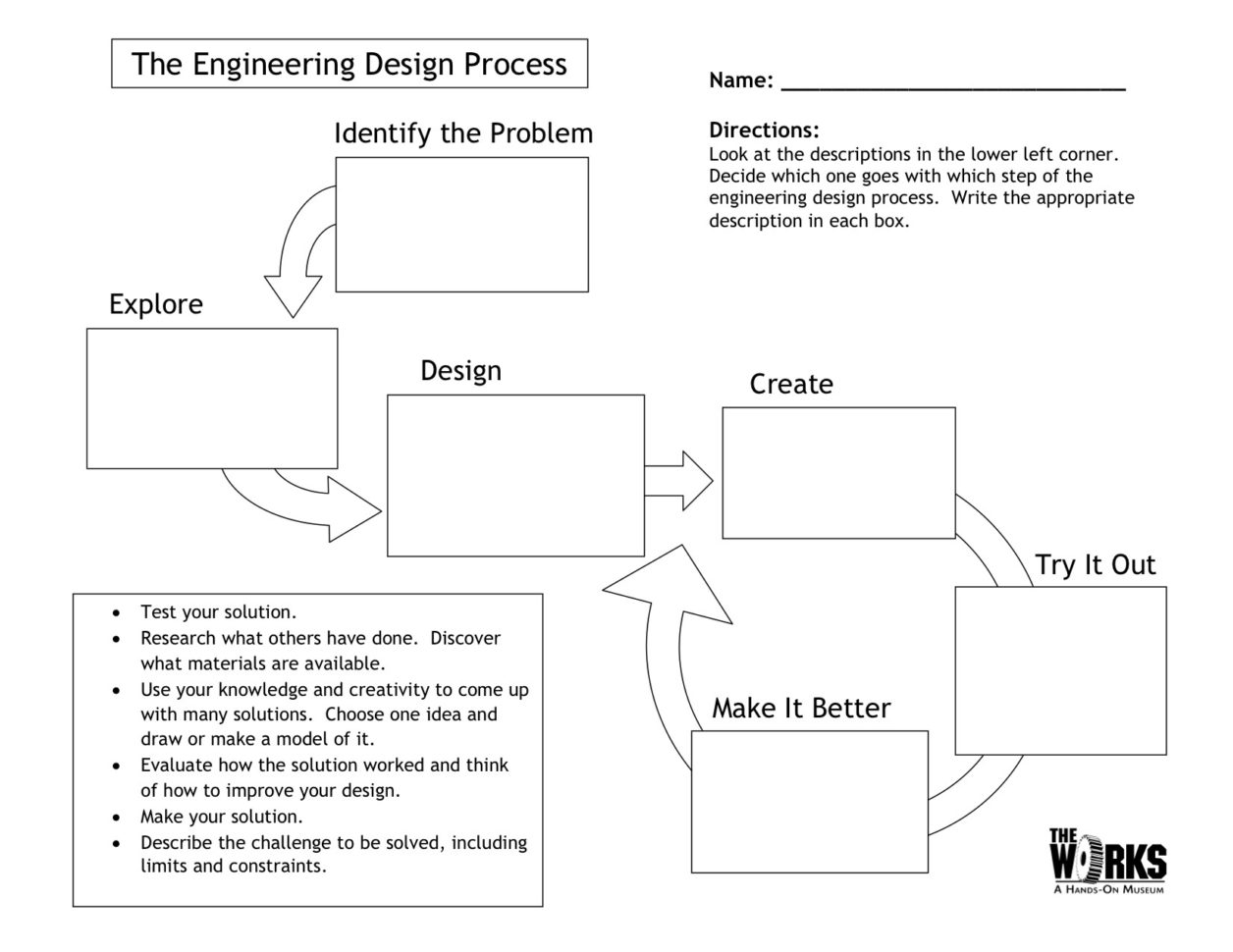
As students learn about the creation of biodomes, they are introduced to the steps of the engineering design process, including guidelines for brainstorming. They learn how engineers are involved in the design and construction of biodomes and use brainstorming to come up with ideas for possible biod... The engineering design process is a series of steps that guides engineering teams as we solve problems. The design process is iterative, meaning that we repeat the steps as many times as needed, making improvements along the way as we learn from failure and uncover new design possibilities to arrive at great solutions.
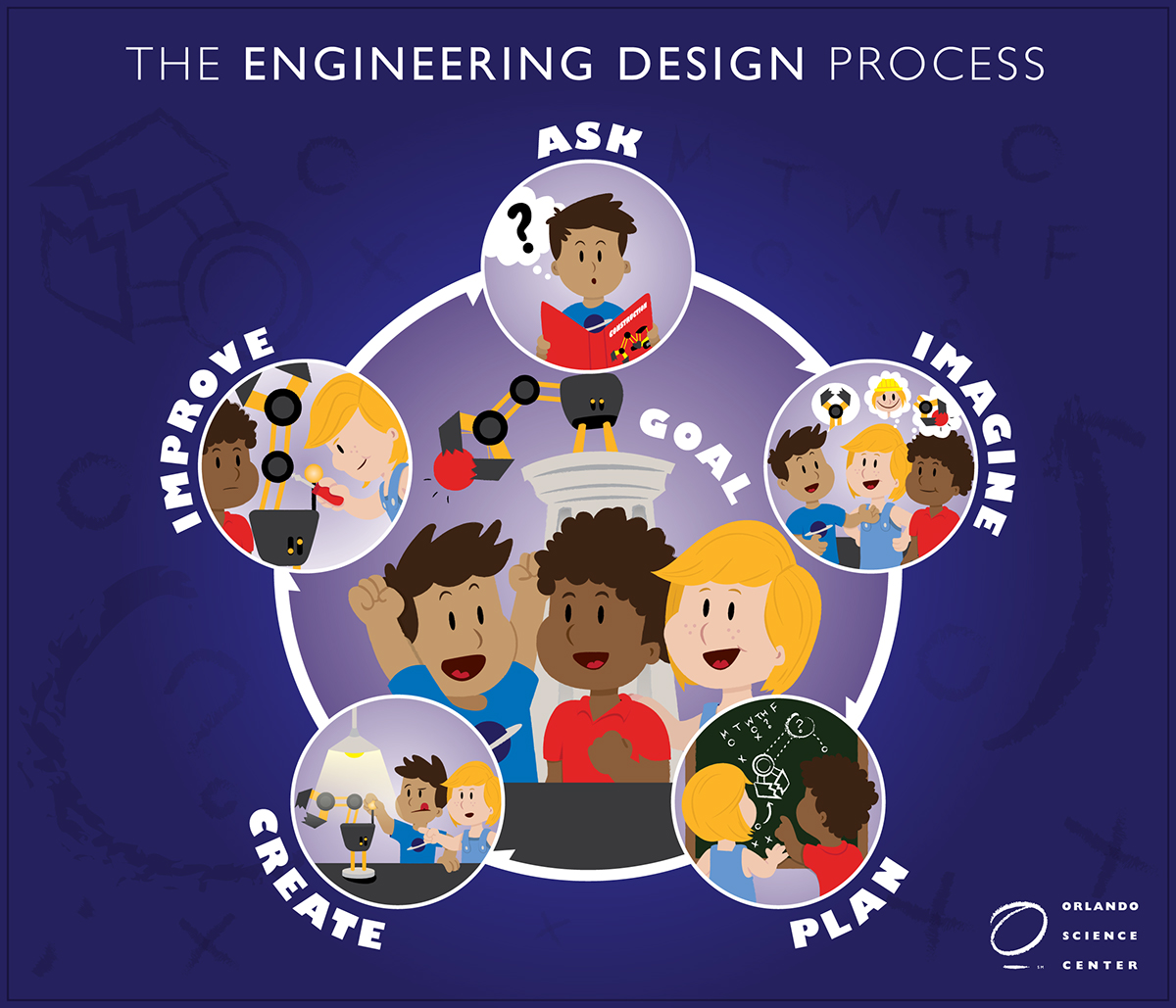
Steps in the engineering design process
A model consists of two layers of a medium separated by material acting as the membrane. Students apply their knowledge of constructing and programming LEGO® MINDSTORMS® robots to create sumobots—strong robots capable of pushing other robots out of a ring. To meet the challenge, groups follow the steps of the engineering design process and consider robot structure, weight and gear ratio...
Activity Extensions
Students learn how to control an Arduino servo wirelessly using a simple phone application, Bluetooth module and an Android phone. Students use Arduino microcontrollers and light-sensitive resistors (photocells) to sense the ambient light levels in a room and turn LEDs on and off based on those readings. They are challenged to personalize their basic night-lights with the use of more LEDs, if/else statements and voltage divider... Students are given a difficult challenge that requires they integrate what they have learned so far in the unit about wait blocks, loops and switches. They incorporate these tools into their programming of the LEGO® MINDSTORMS® robots to perform different tasks depending on input from a sound sensor...
Free Meeting Agenda Examples & Templates That Work
Explore to Flight: Educators Launch a Lunar Buggy Through the Engineering Design Process - NASA
Explore to Flight: Educators Launch a Lunar Buggy Through the Engineering Design Process.
Posted: Fri, 01 Feb 2019 08:00:00 GMT [source]
Each decision must be carefully considered and justified based on various factors such as function, safety, cost, and feasibility. Throughout the process, engineers must weigh the benefits and drawbacks of different options and choose the best course of action based on their knowledge, experience, and the available resources. Justifying decisions is an essential part of the design process as it helps to ensure that the final product meets the required specifications and functions as intended. By justifying each decision, engineers can also communicate their thought process to others involved in the project, such as clients, stakeholders, or team members, and gain their trust and support.
Solutions
Now that the testing phase is complete, your team can revise and improve the product. This step can be repeated several times based on the feedback you receive from teammates, management, clients, customers, investors, and stakeholders. Generate a list of potential alternatives that could effectively solve the problem identified in step one. Considering other options at this stage will make it easier to determine solutions for future challenges. Calibration is the process of verifying and adjusting the accuracy of measuring equipment or instruments. The engineering design process helps ensure that the equipment or instruments are designed to be accurate and reliable, which makes the calibration process more effective.
What is the engineering design process?
Improve upon your existing prototype or design a new iteration of the prototype and test your product again. Repeat the testing and improvement process as many times as necessary to yield the best possible product. Draw up a product design to solve the problem while addressing constraints and potential issues that may arise during the build. This involves selecting the most promising ideas and assessing their feasibility.
Research: Homework time
Student groups are challenged to program robots with color sensors to follow a black line. Learning both the logic and skills behind programming robots for this challenge helps students improve their understanding of how robots "think" and widens their appreciation for the complexity involved in pro... Students learn how to use wind energy to combat gravity and create lift by creating their own tetrahedral kites capable of flying. They explore different tetrahedron kite designs, learning that the geometry of the tetrahedron shape lends itself well to kites and wings because of its advantageous str... Whether on Earth or in space, life-threatening illnesses may occur if the water we drink is of poor quality. It’s up to your students to design and build a filtration system for the International Space Station so they can guarantee astronauts get the safe and clean water they need.
Products and services
Students play the role of biomedical engineers in this activity and create a device that helps visualize heartbeats. Students apply their knowledge of linear regression and design to solve a real-world challenge to create a better packing solution for shipping cell phones. They make composite material packaging containers using cardboard, fabric, plastic, paper and/or rubber bands to create four different-weight p... Students create a water bottle from common materials used in purification tools that can clean dirty water as an inexpensive alternative to a modern filter. Students may iterate upon their design based off their experiment and the designs of their classmates after initial testing.
Engineering Design - Example Projects
Use the Investigating Questions to lead a class discussion about how to recognize the need and identify a target audience for a hypothetical engineering project. Fellow helps your team build great meeting habits through collaborative agendas, real-time notetaking, and time-saving templates. The next time you and your team are tasked with a project, follow our 11 steps to give yourself a high chance of success.
Students apply their knowledge of scale and geometry to design wearables that would help people in their daily lives, perhaps for medical reasons or convenience. Like engineers, student teams follow the steps of the design process, to research the wearable technology field (watching online videos an... Working as if they were engineers, students design and construct model solar sails made of aluminum foil to move cardboard tube satellites through “space” on a string.
Students design a temporary habitat for a future classroom pet—a hingeback tortoise. The students investigate hingeback tortoise habitat features as well as the design features of such a habitat. Each group communicates and presents this information to the rest of the class after they research, brai... Development involves the refinement and improvement of a solution, and it continues throughout the design process, often even after a product ships to customers. When worksheets are completed, lead a class discussion to explore students' responses to the worksheet questions. Ask each team to present their answers to one section of the worksheet.
The evaluation should take into account technical feasibility, economic viability, and market potential. In mechanical engineering, the design process involves a heavy emphasis on material selection, stress analysis, and the integration of mechanical components. It also typically requires extensive testing for safety and functionality.


No comments:
Post a Comment